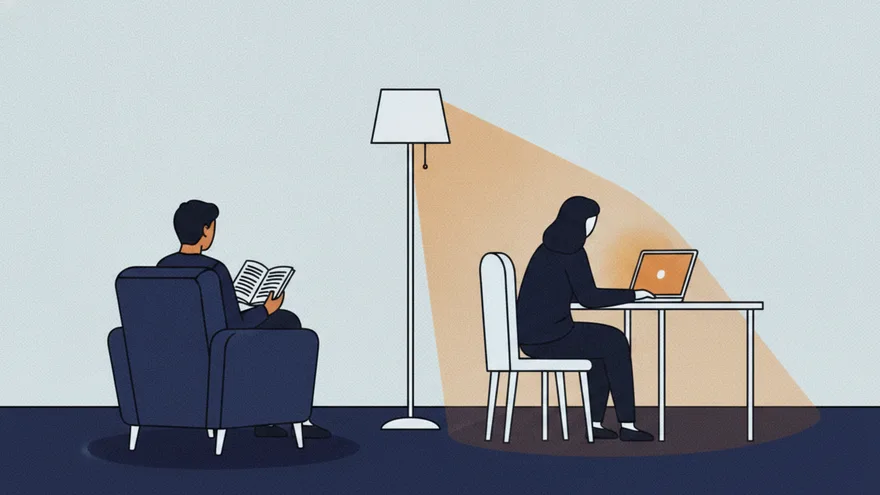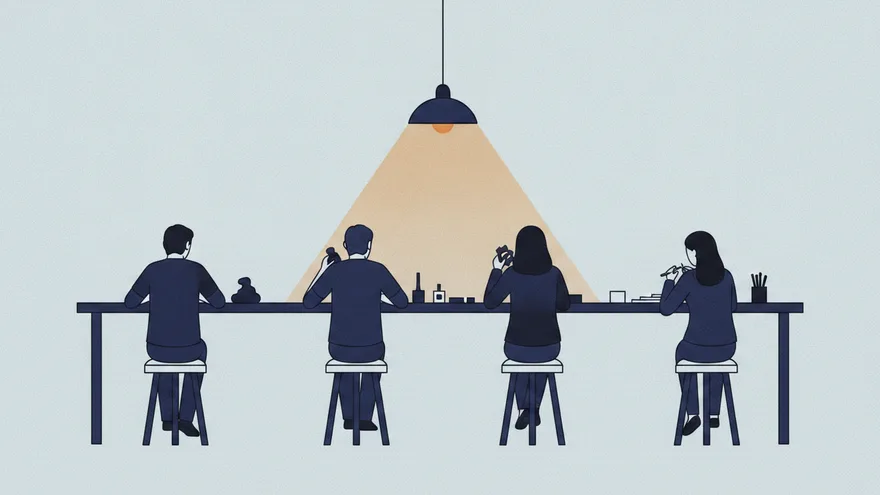
- Noisehow much competing sound and crowd
- low
- Durationhow long the format expects you to stay
- high
- Exit costhow awkward leaving early is
- low
- Recoveryhow much quiet it takes afterwards
- medium
Quiet and easy to close, but open-ended by design: the cost here is duration, not volume. Editorial estimate, ordinal labels only.
Editorial estimate, not a measurement. Three steps only — low, medium, high. We publish no number on this scale because there is no number to publish.
Introvert online dating is ordinary online dating judged on a different axis: not which app has the best reputation, but what its format demands in energy. Most pages on the subject rank apps by mood, not by mechanics. We rank the mechanics, because a format is what actually spends your energy: how fast the product pushes you from writing to talking, whether matches arrive one at a time or as an endless feed, and how much of your profile has to be a performance. Those three axes explain more than any “best for quiet people” badge.
Scale first, so the choice is in proportion. Pew Research Center reported in 2023 that 30% of U.S. adults say they have ever used a dating site or app, and that 9% had used one in the past year, from a survey of 6,034 adults fielded in July 2022. Online dating is a normal route, not a last resort, and it is also not where most people are in any given year.
Pew Research Center (2023) found that having tried online dating is an ordinary thing for U.S. adults to have done, while being active on it in any given year is a much smaller minority.
Who these figures describe
- Have ever used a dating site or app / Used one in the past year — U.S. adults
Source: Pew Research Center, 2023. See how we check numbers.
Show these numbers as a table
| Group | Value | Who it describes | Source |
|---|---|---|---|
| Have ever used a dating site or app | 30% | U.S. adults | Pew Research Center, 2023 |
| Used one in the past year | 9% | U.S. adults | Pew Research Center, 2023 |
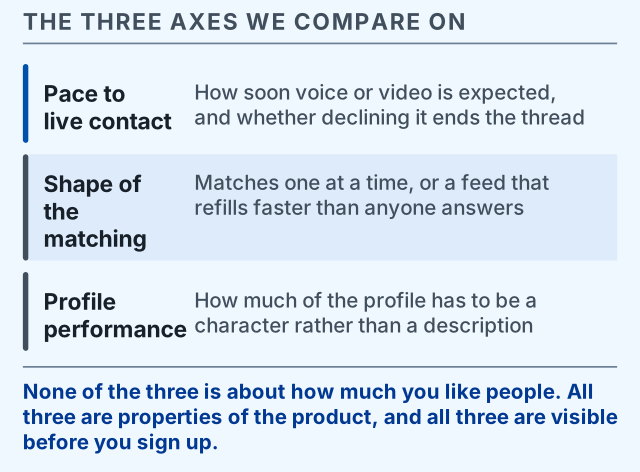
Which three axes matter?
Pace to voice, matching shape, and how much of the profile has to be a performance. Everything else a product advertises sits downstream of those three.
Pace to voice is how soon a product expects you to move from text to a call or a video. Some treat text as a waiting room and push within days. Others leave the handover entirely to you. This single difference decides more of the energy cost than any other feature, because writing is the cheap stage and live contact is the expensive one.
Matching shape is whether people arrive one at a time or in a stream with no end. A queue that shows one person at a time is a finite task. A feed is not. Open-ended formats are where an evening goes, and the cost is duration rather than intensity: nothing about it feels draining while it happens.

Profile performance is how much of the profile has to be a character rather than a description. Prompts that reward wit ask you to be a character. Prompts that ask for specifics let you be a filter. The second kind produces fewer matches, which is the point when each match has a price.
A fourth axis is worth naming, even though products rarely advertise it: what a non-answer costs. Formats where silence is visible to the other person raise the stakes of every reply. Formats where messages simply expire do not. Consider a read receipt: it turns a non-answer into a message of its own.
How do the app formats compare?
On the three axes above, and by archetype rather than by brand name.
Disclosure. This site is funded by affiliate links to dating platforms. There are none in this section, and there is a reason: we have not verified any platform’s current format or price ourselves, and we do not publish a ranking assembled from other people’s marketing copy. When prices are checked, they appear with the date they were checked, per our editorial policy. Until then, the comparison below is of format archetypes, which is the layer that actually predicts cost.
| Format archetype | Pace to voice | Matching shape | What it costs you |
|---|---|---|---|
| Text-first, one match at a time | You decide | Queue, finite | Low per session, slow overall |
| Swipe feed with open chat | You decide | Feed, endless | Duration: the session has no built-in end |
| Prompt-heavy profile app | Usually written first | Feed with hooks | Setup and upkeep: the profile is a performance |
| Weekly curated match | You decide | One or a few per week | Low energy, high patience |
| Video-first or call-to-match | Forced, early | Varies | Highest: live contact before you know you want it |
| Event and group formats | Live from the start | Group | Noise, plus no private exit |
Format archetypes, not brands. Editorial assessment of what each format demands. Checked on 12 August 2026; we re-check this page every six months.
Read the table as a sorting tool rather than a verdict. Two products can share an archetype and still differ on the detail that decides it for you, such as whether an unanswered message expires or sits there, and the only way to find out is a free account and fifteen minutes: does this format let you stay in writing until you want to stop?
The energy arithmetic underneath this is the same one that governs the rest of dating, and it has no units. There is no measured capacity for a social battery, no published norm, and no research establishing how long recovery takes after contact. Anyone printing hours is inventing them. What is defensible is the ordering: live contact costs more than written contact, groups cost more than one-to-one, and open-ended formats cost more than finite ones.
What don’t we recommend?
Anything that spends the cheap stage of dating on the expensive one, and any ranking that hides its axis of comparison.
Mandatory video onboarding. Any product that gates matching behind a live call converts the cheapest stage of dating into the most expensive one, before you know whether you want to meet the person at all. For a shy user in particular, this removes the one advantage the written stage offers: time to draft.
Ranked “best apps for introverts” lists with no axis of comparison. They are almost always ordered by commission rate. Ours has axes and no names, which is less useful and more honest.
The dating-app burnout statistic. A widely quoted figure claims most app users are burned out. We traced it to a commercial survey run for a publisher’s affiliate-adjacent vertical, with no probability sample and no published margin of error, so it does not appear on this site in any form. The nearest defensible measurement is narrower and comes from Pew Research Center’s 2023 report: 36% of Americans who used a dating site or app in the past year said they had at least sometimes felt overwhelmed by the number of messages they received, with women at 54% and men at 25%. That is message volume, not burnout, and we will not relabel it.
Quizzes that “measure” your social battery. There is no validated scale, so any score is decoration.
The idea that the feed is neutral. Volume is not free for anyone. Pew Research Center’s 2023 report also found that 55% of past-year users had at least sometimes felt insecure because of the lack of messages they received, higher among men at 64% than women at 40%. A format that makes both too many and too few messages feel bad is a format worth using deliberately rather than continuously.
One boundary, stated plainly. If the prospect of any contact produces fear that persists and interferes with ordinary life, that is a different question from temperament: social anxiety disorder is a clinical condition, not a temperament, and it belongs with a professional rather than with a dating site. We set out where that line sits, with the figures, on introvert vs shy. This page gives no treatment advice.
How do you write a profile that isn’t a performance?
Specificity beats enthusiasm, and it is also cheaper. “Always up for anything” attracts volume from people who have learned nothing about you. A concrete detail, the kind that would only be true of you, attracts the small number of people it was written for.
Three things worth putting in writing:
- One fact with a texture to it. Not “I love reading” but what you are reading and why you have not finished it — for example, the book you have been stuck halfway through for a month. Something a reader can answer.
- How you like to meet. Short, quiet, early in the day. This filters harder than any adjective and reads as a preference, not an apology.
- Your pace toward calls. Saying that you move to voice slowly sorts people at the point where the sorting is still cheap.
What not to include: the word “introvert” on its own. It means something different to every reader, and a chunk of them will hear “shy” or “difficult”. Describing the behaviour skips the argument.
Photos follow the same rule. One clear picture of your face, one of you doing the specific thing you named, and nothing that requires you to perform an energy level you do not have on a normal Tuesday. Nobody is grading composition.
Is online dating good for introverts?
For the written stage, yes, and the reason is structural rather than motivational: you reply when you have energy, you can think before answering, and no one sees you pause. That is the one context where being the person who considers their words is an advantage rather than a lag.
The evidence on outcomes is mixed for everyone, not specifically for quiet people. Pew Research Center reported in 2023 that 53% of Americans who have used a dating site or app described their personal experiences as very or somewhat positive, while 46% described them as very or somewhat negative. The same body of work found that 10% of partnered U.S. adults met their current spouse or partner on a dating site or app, rising to about one in five among partnered adults aged 18 to 29. Usage skews young: 53% of U.S. adults under 30 have ever used a dating site or app, against 37% of those 30 to 49, 20% of those 50 to 64 and 13% of those 65 and older.
One thing we cannot tell you, because nobody can. There is no figure for how introverts fare on apps compared with extroverts. No representative survey crosses a personality measure with app usage, so any such number in circulation is an invented cross-tab. There is not even a defensible figure for how many people are introverts: extraversion is measured as a continuous dimension with no agreed cut-point, so the honest number is self-description. YouGov’s 2023 poll of 1,000 U.S. adults found that 39% describe themselves as introverts, which is a fact about identity, not a census of temperament. We keep that distinction on our statistics page.
What we do think is defensible, and it is a recommendation about method rather than product: treat an app as a scheduled task, not an open tab. A fixed slot, a small number of live conversations, and a rule about when writing becomes a meeting. Feeds are built to be open-ended, so the ending has to come from you.
An editorial note on how we assess. Every cost label on this site is an ordinal editorial judgement, never a measurement. Where a number exists, we name the publisher and the year in the same sentence. Where one does not, we say so instead of estimating. That is why this page has no scores out of ten.
If the app stage is going fine and the meeting stage is where the energy goes, the format question moves with you to the first date, and the rest of it is on our dating hub.
If apps are not the route you want, the settings that work offline run on the same axes and are covered in being a social introvert. And if the app stage has already produced someone, what changes once two quiet people are actually together is on introvert relationships.