
- Noisehow much competing sound and crowd
- low
- Durationhow long the format expects you to stay
- medium
- Exit costhow awkward leaving early is
- low
- Recoveryhow much quiet it takes afterwards
- low
Costs more minutes than a party and less energy, because week three needs no introductions.
Editorial estimate, not a measurement. Three steps only — low, medium, high. We publish no number on this scale because there is no number to publish.
An introvert social life is one built out of repeat contact with a few people rather than out of volume. It exists, it works, and it looks nothing like the one people keep recommending to you: it is smaller, more repetitive, and planned further ahead. The advice that fails is almost never wrong about wanting connection — it is wrong about the format in which connection is supposed to happen.
This page is about where introverts meet people, why some settings cost so much for so little, and what to do with the ones that do the opposite.
Is “social introvert” a contradiction?
No. A social introvert is someone who seeks out people deliberately rather than by default, and who still needs a quiet evening afterwards. The phrase sounds like a joke about yourself, and it isn’t one. Introversion describes what drains you. It does not describe whether you like people, whether people like you, or how well you do in a conversation once you are in it.
That distinction is not a wellness-blog invention. In mainstream personality research, extraversion–introversion is one of five broad trait domains in the five-factor model, alongside neuroticism, openness, agreeableness and conscientiousness, as Kajonius and Johnson set out in Europe’s Journal of Psychology in 2019. It is measured as a continuous dimension — a position on a scale, not a box you are in.
That matters for a practical reason. There is no cut-point at which a person officially becomes an introvert, so any claim about how many introverts exist is really a claim about how people describe themselves. In a 2023 YouGov poll of 1,000 U.S. adults, 39% described themselves as introverts. In the same poll, 31% said they were an equal mix of introvert and extrovert and 22% said they were extroverts — which tells you the middle of this scale is crowded.
What the label usually means in practice
- You choose social contact deliberately rather than falling into it
- Depth over headcount: a few people you know well, rather than many you know slightly
- Contact is planned, and so is the quiet afterwards
- Enjoying an evening and needing to recover from it are not in conflict
None of that is shyness. Shyness is fear of being judged; introversion is what a room costs you. Someone can be a confident introvert or a shy extrovert, and mixing the two up leads to advice aimed at a problem you do not have. We separate them properly on introvert vs shy.
Editor’s note. We describe mechanics here, not personal triumphs. This site is signed with a pen name rather than a biography, and we are not going to dress up an anecdote as evidence. Where something is unmeasured, we say so instead of printing a number.
Which settings actually work?
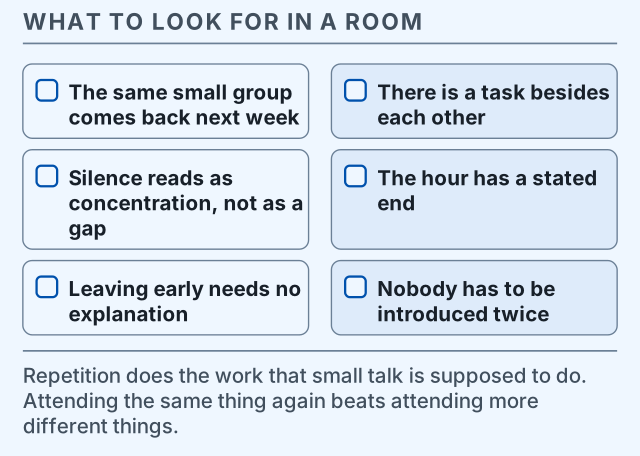
Repeat contact with the same small group is the single property shared by the settings that work for introverts. Not novelty, not volume, not the number of introductions per hour.
Consider what that changes about the arithmetic. In a one-off setting, every conversation starts from zero: you supply the opening, the context, the enthusiasm, and the exit. In a repeating setting, week two starts where week one stopped. By week four, nobody introduces themselves, somebody saves you a seat, and the small talk you dread has quietly been made unnecessary by familiarity.

Repetition also fixes the thing introverts are structurally short of: reps. Friendship and attraction both grow out of repeated exposure, and attending fewer events means fewer chances. The answer is not attending more different events. It is attending the same one again.
A second property: a shared task
The best formats give you something to attend to besides each other, such as a route, a score, a rehearsal or a pile of donations to sort. A shared task means silence reads as concentration rather than as a gap that someone has failed to fill, and it gives you material to talk about that you did not have to invent.
Put the two together and you get a short list that is boringly consistent across the people who report it working:
- Classes that run for a term — languages, pottery, dance, anything with a register
- Weekly sport, climbing gyms, running clubs with a fixed slot
- Choirs, bands, orchestras and other things that rehearse
- Volunteering with a recurring shift
- Board-game nights, book groups, repair cafés, small hobby meetups
- The same café, gym or park bench at the same time, which counts for more than it sounds
How the common settings compare
Cost here means energy demanded, not money. These are our editorial judgements about the format, not measurements — nobody has published a scale for this.
| Setting | Repeat contact | Shared task | Noise | Exit cost | Energy cost |
|---|---|---|---|---|---|
| Weekly class or club | High | Yes | Low | Low | Low |
| Volunteering shift | High | Yes | Medium | Low | Low |
| Small hobby meetup | High | Yes | Low | Medium | Low |
| Dinner party, small group | Low | Partly | Low | High | Medium |
| Large house party | Low | No | High | Medium | High |
| Bar or club night | Low | No | High | Medium | High |
| Networking event | Low | No | High | Low | High |
| Dating apps | Medium | No | Low | Low | Medium |
Checked: August 12, 2026.
Read the table by row, not by score. A weekly class costs more of your calendar than a party and less of your energy, because the calendar is the cheap resource and the energy is the scarce one.
Which settings reliably fail?
The ones with no repetition, no shared task and a lot of noise — which is most of what gets recommended.
We don’t recommend “just go where the people are”. A bar late on a Friday is a high-noise, zero-repetition, no-shared-task format. It demands the largest energy outlay of anything on the list and returns the least information about anyone in it. Failing there is a fact about the room’s acoustics and turnover, not about you.
We don’t recommend one-off events as a strategy. For example, a single meetup, a single speed-dating night or a single festival each restarts you at zero. If you attend a handful of different one-offs, you have had a handful of first conversations. If you attend the same thing that many times, you have a group.
We don’t recommend numeric social targets as rules. Talk-to-five-strangers heuristics turn an evening into a scoreboard you can lose. They are folk advice with no evidence behind them, and for someone counting energy they add a second thing to spend it on.
We don’t recommend advice that treats you as the defect. Much of the category sells a personality change as the fix. It has a ready audience: in that same 2023 YouGov poll, 70% of Americans said extroverts have more advantages than introverts at parties, versus 7% who said introverts do. That is a measure of public opinion about a specific setting — not a finding about outcomes, and not a reason to become someone else. The cheaper move is to change the setting.
Where we stop. If the barrier is dread rather than energy cost — if the anticipation of being watched or judged is what keeps you home, and it has been shaping your life for months — that is the social anxiety axis, not the introversion one, and it is treatable by people qualified to treat it. We are not those people and we do not give therapeutic advice. A GP or a clinical psychologist is the right next stop.
How do you get from meeting to dating?
The bridge is shorter than it looks, because a repeating setting has already done the two things a first date usually has to do from cold: established familiarity and given you a shared subject. Asking someone from your Tuesday class to get a coffee after it is a smaller step than any opening line on any app.
Two practical notes. First, the format of the first meeting matters more than the venue — a shared focus and an exit inside an hour. Second, meeting through an activity and meeting through an app are not rivals; they fail in different ways and most people end up using both. The rest of the funnel — apps, profiles, reading a quiet partner — sits on the dating hub.
If what you want is friendship rather than romance, the mechanics are the same but the timeline is longer: repeat contact does the work either way. What changes is what happens when two quiet people do click — that part is on introvert relationships.
What can nobody measure?
Two things: the size of a social battery and the time it takes to recover from an evening out. Both gaps get filled with invented numbers everywhere else.
There is no measured size for a social battery. It is a useful metaphor and nothing more: no validated scale, no published norm, no unit. Anyone quoting you a capacity is quoting a blog. What the metaphor is good for, and where it stops, is the subject of the social battery hub.
There is no measured recovery time either. How long you need after an evening in a loud room has not been established by anyone we could cite, so we will not print hours. You can observe your own pattern across a few weeks. That tells you nothing about anyone else, and it is still better than a number someone made up.
Every figure we do use is listed with its source, year and method on our statistics page, including the widely repeated MBTI split we refuse to print because it could not be traced to a source we could open.
What should you actually do this month?
- Pick one repeating thing with a fixed weekly slot and a task attached to it.
- Commit to a month of it before judging. The earliest sessions are the expensive ones.
- Go earlier rather than staying longer; leave while it is still going well.
- Schedule the recovery, so a quiet Sunday is a plan rather than a retreat.
- Ignore anyone counting your conversations, including you.
Nothing on that list asks you to become more outgoing. It asks you to stop paying full price for formats that were never built for you.