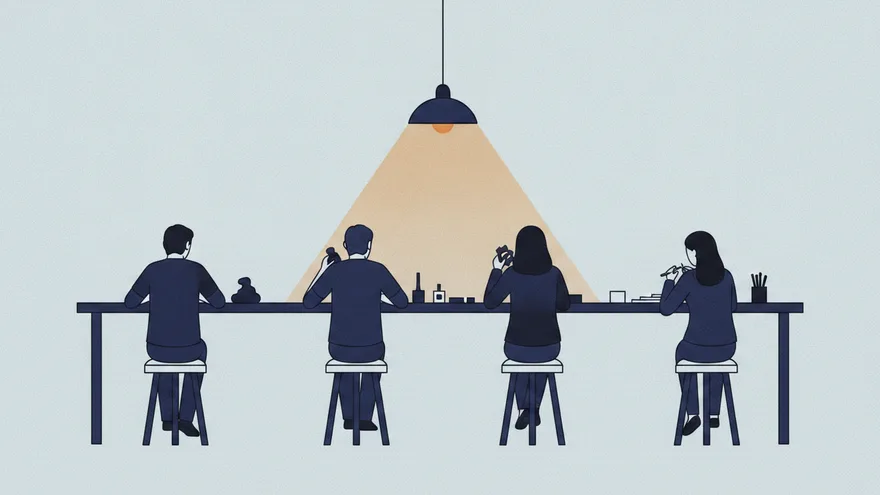
Dating for introverts is ordinary dating run on a stated energy budget rather than an unstated one. Nothing about the wanting is different: the appetite for someone to know well is the same appetite everyone else has. What differs is the accounting. Contact draws on a reserve that refills slowly, and the default dating calendar is built by people for whom it refills fast, which is why the standard advice keeps missing.
So this section rates formats instead of rating people. Every page here carries the same four-axis reading — noise, duration, exit cost, recovery — and the reading is an editorial estimate on three ordinal steps, never a score. There is no number on any of those scales, because there is no measurement behind one.
What do the four axes actually measure?
They measure what a format takes, not what a person lacks. Noise is how much work the room adds to talking: a venue loud enough that you have to lean in has turned conversation into labour before anyone has said anything interesting. Duration is the committed length — not how long it might run, but how long you have agreed to before you can politely go.
Exit cost refers to what it takes to end the thing early. A walk ends itself when the loop closes; a booked dinner ends when the plates are cleared, and leaving before that requires an excuse, so the format has quietly bought your whole evening. Recovery is what the format bills afterwards — the hours or the day that go to getting back to normal, which are hours you had probably already spent on something else.
The four are not interchangeable, and the pairing matters more than any single axis. Consider a loud bar for one hour against a quiet dinner for three: the first is high noise and low duration, the second is the reverse, and which one is worse depends entirely on which axis is your expensive one. The point of writing them down is to stop the choice being made by whoever suggested first.
Which dating formats cost the least?
The cheap formats share two properties: a shared focus and a natural end. A shared focus means something to attend to besides each other, so a silence is a pause in an activity instead of a gap somebody has to fill. A natural end means the format finishes itself, so neither person has to be the one who ends it.
For example, a walk with a destination has both — the route runs out, and there is a street to look at while it does. An hour at a small exhibition has both. Coffee before something you have already booked has both, and the booking does the work of the excuse. A long dinner has neither, which is why it is simultaneously the most-suggested first date and the most expensive one on these axes.
Group formats sit oddly on the scale and are worth naming separately, because they are cheap in one way and expensive in another. A small standing group — the same people, the same time, every week — costs a lot on recovery and almost nothing on the thing that usually stops people, which is having to arrive as a stranger and perform an introduction. Familiarity does that work instead. That is the argument set out at length on where introverts actually meet people.
Do dating apps deserve their reputation here?
They deserve a specific complaint rather than a general one. The problem is not that apps are digital; text before contact is the part of the format that suits a quiet person best. The problem is what most apps do next: push toward a voice or video call quickly, present an endless feed rather than a small number of conversations, and reward profile performance.
The scale of the thing is worth stating plainly, and only with a figure that survives checking. A Pew Research Center survey fielded in July 2022 found that 30% of U.S. adults say they have ever used a dating site or app, rising to 53% of adults under 30. That describes reach, not suitability, and we quote it for exactly that much. How the formats differ from each other, and which properties are worth choosing on, is the whole of dating apps for introverts.
When is the difficulty not about energy at all?
When the discomfort arrives during the contact rather than after it. That single timing question sorts most of the confusion in this niche. Introversion bills afterwards, as depletion, and it does so whether or not you were comfortable. Shyness charges during, as apprehension about being judged, and it fades with familiarity in a way that an energy cost does not.
The two need opposite things, which is why using the wrong one wastes months: cheaper formats help an energy problem and barely touch a fear problem, while the repeated contact that dissolves shyness costs energy. Someone can have both at once, and the useful move is to ask which bill arrived rather than to look for one answer.
Further along the same line sits something clinical and separate. Social anxiety disorder is a diagnosis rather than a stronger flavour of being quiet: the National Comorbidity Survey Replication, reported by Ruscio and colleagues in Psychological Medicine in 2008, estimated that 12.1% of U.S. adults experience social phobia at some point in their lives. We print that to mark that the condition is real and treatable, not to hand anyone a self-test. The full distinction is on introvert vs shy.
Where does this section stop?
It stops where description would turn into diagnosis, and it stops in three specific places worth naming.
- It does not tell anyone to change. Introversion is a trait, not a defect awaiting correction, and there is nothing here about becoming more outgoing.
- It does not print numbers it could not trace. The widely repeated figure for the share of the population that “is” introverted failed checking and appears nowhere on this site; the sources page lists what passed and what was thrown out.
- It does not give therapeutic advice. Where a page reaches the clinical boundary it points at a professional and stops, rather than carrying on in a softer voice.
Underneath all of it is the reserve the formats are drawing on, which has its own section: what a social battery is, where the metaphor is accurate and where it is not.