- Noisehow much competing sound and crowd
- low
- Durationhow long the format expects you to stay
- medium
- Exit costhow awkward leaving early is
- low
- Recoveryhow much quiet it takes afterwards
- low
Cheap to hold every week, which is exactly why it quietly becomes the only plan.
Editorial estimate, not a measurement. Three steps only — low, medium, high. We publish no number on this scale because there is no number to publish.
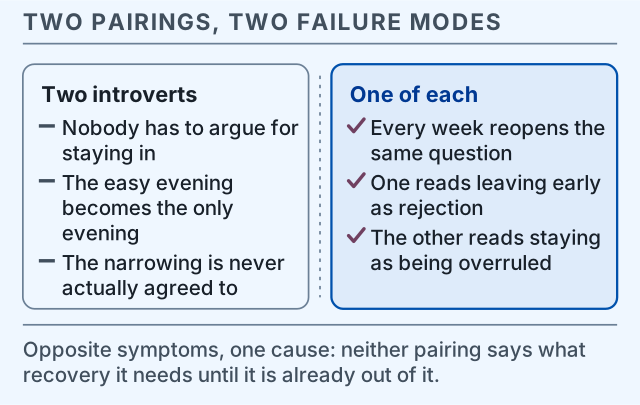
An introvert–introvert relationship is a pair in which contact is expensive for both people, which is why it rarely argues about whether to go out. That is the whole problem, and it takes months to become visible.
An introvert–extrovert pair has the opposite argument, weekly, and it looks worse from the outside while usually being easier to fix. Both patterns run on the same missing sentence: nobody says what they need to recover until the recovery is already overdue.
What goes wrong when both partners are introverts?
They drift, and nothing announces it. Drift is the slow contraction of a shared social world that nobody ever argued against. When both partners find contact expensive, every cancellation is agreed instantly. The evening out becomes the evening in, the dinner with friends becomes takeaway, and neither of you ever has to make the case for staying home, because the case has already been won.
That is comfortable and it compounds. After a few months the shared social world has thinned to whatever survives without effort, such as family obligations and work. The pair has not chosen isolation; it has simply never had a conversation in which anyone argued for the harder option.
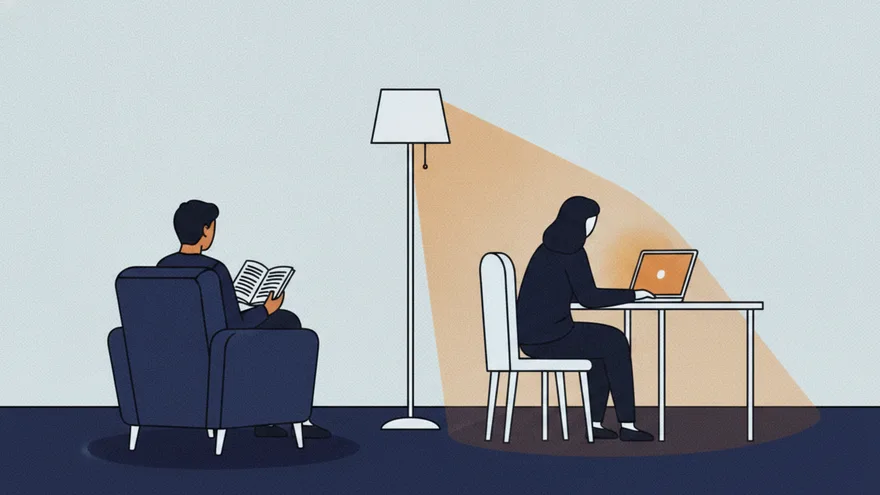
The second version of the drift is internal. Two people who both recharge alone can spend an evening in the same room without exchanging anything, call it closeness, and be right about it for a long time — until one of them starts counting how long it has been since a real conversation. Quiet is not the failure. Quiet that nobody has checked on is.
What prevents it is not forcing yourselves out. It is one standing arrangement a month that you do not renegotiate each time, and a habit of asking what the other person actually wants rather than what is cheapest.
What goes wrong in an introvert–extrovert pair?
They disagree about pace. The pace problem is a disagreement about how many evenings a week count as normal, held by two people who each believe their own number is the neutral one. This pair does not disagree about whether they like each other.
The damage rarely comes from the number. It comes from what the number gets translated into. Consider an early exit from a party: the introverted partner is doing arithmetic about tomorrow, while the extroverted partner watching them leave is often reading a verdict on the party, the friends, or themselves. Two accurate people, two different subjects.
The reverse translation is just as common. An extroverted partner who wants more evenings out is usually describing their own recovery need, not a complaint about the company at home. Contact restores them. That is not a criticism of you.
Popular labels do not resolve this. Ambivert, omnivert and extroverted introvert are folk terms rather than measured categories, and treating one as an explanation ends the conversation early. What resolves it is a number agreed in advance, plus permission for either partner to attend something alone without it being an incident.
For what this looks like on dating apps, before any of it is a relationship, see our review of the apps and how their formats price contact.
Which conversation prevents both?
It is one conversation, held when nothing is wrong, and it has three questions: how many evenings out is a normal week, what happens when one of us wants to leave early, and what does each of us need on the day after something heavy.
The table below is the version we keep. The left column is the moment; the middle is what usually gets said instead; the right is the thing that was actually being asked for.
| Situation | What each partner usually says | What’s actually needed |
|---|---|---|
| Friday, both worn out | “I don’t mind, whatever you want” | One of you names a default, so the week does not decide by attrition |
| A party invitation lands | “Sure, we’ll go” / “You go if you want” | An agreed leaving time, said before the yes, not during the evening |
| One of you goes quiet at home | “Are you annoyed with me?” | A phrase that means recovery, not distance — agreed while calm |
| The day after a wedding or a work event | Nothing is said, plans stay booked | A protected gap, put in the calendar when the event was booked |
| Long distance, nightly video call | “We should talk more” | Shorter calls more often, and more written between them |
| One partner wants a night out alone | “Don’t you want to spend time with me?” | Permission that was granted once, in advance, rather than requested each time |
Checked on August 12, 2026. We re-check this page every six months.
Two things to say plainly about the phrasing in the right-hand column. It works better as a standing rule than as a request in the moment, because in the moment it lands as rejection. And it works in both directions: the extroverted partner’s night out needs the same advance permission as the introverted partner’s early exit.
How common is any of this?
Less measurable than the internet suggests. There is no share of the population that “is” introverted, because extraversion is measured as a continuous dimension with no agreed cut-off point. What exists is self-description: in a 2023 YouGov poll of 1,000 U.S. adults, 39% described themselves as introverts, while 31% said they were an equal mix and 22% called themselves extroverts.
Read that middle number before you sort your relationship into a type. Nearly a third of people decline the box entirely, which is a fair warning against building a couple’s operating manual on two labels.
Nor is there a figure for how often introverts partner with each other, or for whether mixed pairs last longer. We looked, and every candidate source was either untraceable or an industry estimate without a probability sample, so this page runs on described mechanics instead. More on what is and is not measured is on our statistics page.
Where the couple met is measured. Pew Research Center reported in 2023, from a survey of 6,034 U.S. adults, that 10% of partnered U.S. adults met their current spouse or partner on a dating site or app, rising to about one in five among adults aged 18 to 29.
10%
Met their current spouse or partner on a dating site or app
Pew Research Center (2023) asked people who are currently married, living with a partner or in a committed relationship where they met, so this describes couples who are together now rather than everyone who has ever dated online.
Who these figures describe
- U.S. adults who are married, living with a partner, or in a committed relationship
Source: Pew Research Center, 2023. See how we check numbers.
Show these numbers as a table
| Group | Value | Who it describes | Source |
|---|---|---|---|
| Met their current spouse or partner on a dating site or app | 10% | U.S. adults who are married, living with a partner, or in a committed relationship | Pew Research Center, 2023 |
Which problems actually recur?
Three complaints come up more than the rest, and none of them is really about temperament.
The first is the message backlog. One partner replies within minutes, the other replies when they have the capacity to compose something, and the gap gets read as interest cooling. It usually is not. Agreeing in advance on what a slow reply means — for example, that it stands for “later today” rather than “thinking about it” — removes most of the sting.
The second is the debrief. After an event, one partner wants to talk it over immediately and the other needs the drive home in silence first. Both are recovery behaviours. They look like opposites, and the one who wants to talk is usually the one who ends up feeling rejected.
The third is the guest problem: people in the house on a schedule agreed weeks ago by someone who was not tired yet. The fix is dull and it works, which is to book the recovery gap at the same moment you accept the visit, in the same calendar.
What we don’t do
We don’t tell you to want more contact. Wanting fewer evenings out is not a deficit to be corrected, and a relationship built on one partner performing an appetite they don’t have is worse for both of them than an honest schedule.
We don’t print a recovery time. No measurement of how long it takes to recover after social contact exists in any source we could verify, so any rule you read that puts a number of hours on it is somebody’s guess with a figure attached. The social battery hub explains why the metaphor has no units.
We don’t diagnose your partner from their silence. Quiet has many causes and most of them aren’t temperament. Reading a personality type into a bad week is how couples end up managing a label instead of a person.
We don’t sell reassurance about your odds. Nobody can tell you whether your pairing works, because nobody has measured it.
What this is not
This page is about temperament and scheduling. It is not about attachment patterns, and it does not describe what happens when one partner withdraws in a way that has nothing to do with recovery. That is a different subject and a different kind of source.
It is also not a clinical page. Introversion is not shyness and it is not social anxiety disorder; they can occur together and they are not the same thing. If contact has stopped being expensive and started being frightening, or if withdrawal is going with sleep, appetite or mood changes, that belongs with a professional rather than with a dating site. We don’t give therapeutic advice and we won’t try here.
If the quiet is the part you are trying to read rather than live with, the signals worth reading are on dating a shy guy — and the trait-versus-fear distinction underneath all of it is on introvert vs shy. For everything upstream of a relationship, start at the dating hub.