
- Noisehow much competing sound and crowd
- medium
- Durationhow long the format expects you to stay
- high
- Exit costhow awkward leaving early is
- medium
- Recoveryhow much quiet it takes afterwards
- high
Same total contact as a week with a gap in it, and far more expensive. Order is the variable.
Editorial estimate, not a measurement. Three steps only — low, medium, high. We publish no number on this scale because there is no number to publish.
Almost every guide on how to recharge a social battery answers with a duration. Take an hour. Take a day. Give yourself the weekend. We went looking for the measurement behind those numbers and there isn’t one, so none of them appear here.
How to recharge a social battery is a question about mechanism rather than duration, and the mechanism can be described even where the hours cannot. The recovery has a shape: a stretch of time in which nothing is waiting on a response from you, placed before the next commitment rather than after three of them.
What does recovery require?
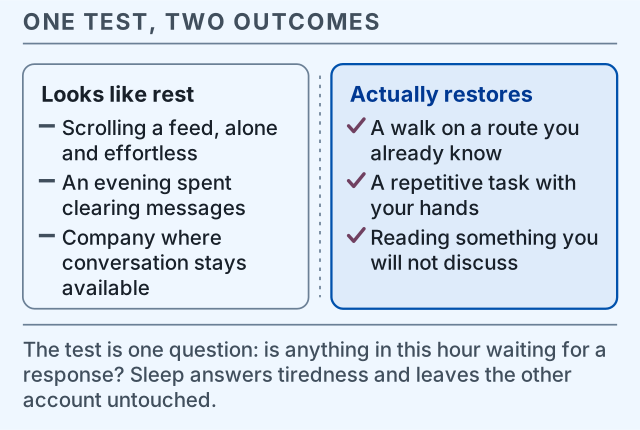
One property does most of the work: solitude that isn’t also stimulation. Stimulation is anything asking you for a response, which is why a group chat counts as contact and a walk on a familiar route does not.
The test is simple to apply. Is anything asking you for a response? A group chat is. A feed is. A television drama is, mildly, because it holds attention on other people’s faces. A walk along a route you already know is not, and that is why it keeps showing up in descriptions of what worked.

| How the gap is spent | Alone? | Anything awaiting a response? | Counts as recovery |
|---|---|---|---|
| Walk on a familiar route, phone in pocket | Yes | No | Yes |
| Repetitive task: cooking, tidying, an instrument | Yes | No | Yes |
| Reading something you are not going to discuss | Yes | No | Yes |
| Scrolling a feed | Yes | Yes, continuously | No |
| Evening at home clearing messages | Yes | Yes | No |
| Sleep | Yes | No | Handles tiredness only |
| Quiet company, no conversation required | No | Depends on the person | Sometimes |
The last row is the one people argue about, and the honest answer is that it varies. Some people recover perfectly well in a room with someone who expects nothing. Others find that the mere availability of conversation keeps the machinery running. Both descriptions are common and neither is a defect.
Why sleep alone doesn’t do it
Sleep is what repairs tiredness. The load left by contact is a separate account, and the evidence for that is ordinary experience: a full night’s sleep after a wedding, and the thought of a phone call still lands badly. If sleep settled it, Sunday morning would reset Saturday night, and for most people it does not.
Practical consequence: an early night after a heavy day is worth having, and it is not the recharge. The recharge is the undemanding hour, and it usually has to be taken while awake.
What feels like rest but isn’t?
Scrolling, clearing a message backlog, batching a week into one heavy day, and taking the gap afterwards rather than before. Each of those looks like recovery on a calendar and doesn’t behave like it, and the failures here are the expensive ones.
Scrolling. Quiet, alone, effortless, and a continuous stream of small social judgements. It resembles rest closely enough to consume the whole gap.
Clearing the backlog. Answering four messages “to get it out of the way” is contact. It is cheaper than a room full of people, and it is not free, and it is usually done in exactly the slot that was supposed to be the gap.
Batching everything into one heavy day. Three arrangements on Saturday to keep the rest of the week clear is a real strategy with a real cost, and the cost is that the recovery gap now has to be large, at the point in the week when it is hardest to protect.
Recovering after instead of before. A gap taken after four commitments is repair work. The same gap taken between the second and the third is maintenance, and it is cheaper.
Calling it a fixed number of hours. Any hours figure in circulation is someone’s estimate. Adopting one gives you a target you can now fail, which adds a second problem to the first.
We also do not run a quiz that tells you your battery size. A social battery is a metaphor rather than a measured quantity: no validated scale, no published norm, no unit, and so nothing to size it against. A number produced by a quiz is a number invented by a quiz.
How do you plan the week around it?
Put the gap in first.
A recovery gap that exists only when nothing else claims it will not exist, because something always claims it. The reverse works better than people expect: arrangements fit around a protected gap far more easily than a gap fits around arrangements, and nobody has ever asked us why Thursday evening was unavailable.
Three rules that survive contact with an actual calendar:
- Never book consecutive evenings if the week has a choice. Two evenings with a day between them is the same total contact at a much lower price.
- Protect the morning after, not just the evening itself. The cost of a Friday lands on Saturday, and a Saturday that opens with an obligation converts one expensive evening into an expensive weekend.
- Distinguish unavoidable contact from chosen contact. Work meetings, the commute, the family call: those are fixed load. The dating week is what remains after them, and sizing it as though the fixed load were free is the most common planning error we see.
If the week is arriving already empty by Tuesday no matter how it is arranged, that is a load question rather than a technique question, and it has its own page: why your social battery runs out so fast.
The part that isn’t in the data
We should be plain about the limits here. Nobody on this masthead has a clinical background, and no study we could find measures recovery time after social contact. Everything above is mechanism and description, not a finding. Where a number would be convenient, we have left a gap rather than filling it, and the full list of what we would and would not stand behind is on the numbers page.
One thing the data does show is why this planning stays invisible. In a YouGov poll of 1,000 U.S. adult citizens conducted in March 2023, 70% of Americans said extroverts have more advantages than introverts at parties, against 7% who said introverts do. That is perceived advantage, not outcomes, but it explains the social script: the person leaving early is read as not enjoying it, rather than as managing a budget.
The same 2023 YouGov poll found that 39% of Americans describe themselves as introverts, which is self-description on a five-point scale rather than a measured trait. There is no cut-off point at which a person becomes an introvert, so there is no count of introverts to quote. What the figure does establish is that the experience is not a niche one.
How do you recharge between dates?
Space them, pick formats that end themselves, and count the app as contact. Dating concentrates the problem, because it is new people, in unfamiliar rooms, with an evaluation running the whole time. That combination is the most expensive one available.
Space the dates, don’t shorten them. For example, two first dates in one week is manageable with three days between them and rough on consecutive nights, even though the hours are identical. Order is the variable you control most cheaply.
Choose formats that end themselves, such as a walk with a loop, a coffee before something else, or an exhibition that closes. A format with a built-in ending removes the second cost, which is the negotiation about when to leave. Our list of these is on being a social introvert.
Count the app as contact. The phase before the date is load too. Pew Research Center’s 2023 report, from a survey of 6,034 U.S. adults fielded in July 2022, found that 36% of Americans who had used a dating site or app in the past year said they had at least sometimes felt overwhelmed by the number of messages they received. That measures message volume, not burnout, and it is the part of dating most often left out of the week’s budget. How the formats differ is covered on dating apps for introverts.
Say the plan out loud, early. “I have an hour tonight” turns an early ending into a stated plan rather than a verdict on the other person. It works considerably better than inventing a reason at the door, and it screens fast for people who treat a stated limit as a negotiation.
Second dates are cheaper than first dates. Familiarity is the lever that usually reduces cost, because a repeat person in a repeat setting demands less introduction work. If the first one went well, the correct move is often to book the second sooner and keep it shorter, not to wait until you feel fully recovered.
The rest of the mechanics, including what the metaphor does and does not describe, sit on the social battery hub.