
- Noisehow much competing sound and crowd
- high
- Durationhow long the format expects you to stay
- high
- Exit costhow awkward leaving early is
- high
- Recoveryhow much quiet it takes afterwards
- high
Editorial estimate on an ordinal scale, not a measurement. There is no unit for this and we do not invent one.
Editorial estimate, not a measurement. Three steps only — low, medium, high. We publish no number on this scale because there is no number to publish.
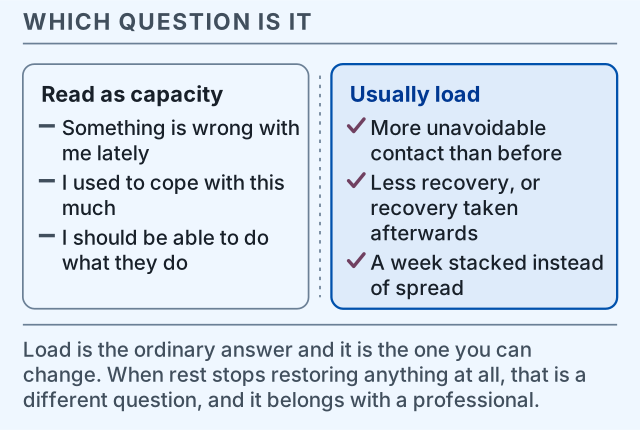
Why is my social battery so low is two different claims sharing one sentence. One is that your capacity is unusually small. The other is that your current week is unusually expensive. They feel identical from inside and they have completely different answers, so the useful first move is to work out which of them you are asking.
Before anything else, the honest disclaimer that most pages on this topic skip: a social battery is a metaphor, not a measured quantity. There is no validated scale, no published norm and no unit, which means nobody can tell you the size of yours, how fast it drains, or how yours compares with anyone else’s. We use the language because people recognise it. We do not attach numbers to it.
Is it load or capacity?
It is almost always load. Capacity is the size of the account, and it is fairly stable. Load is what a given week bills against that account, and load is the thing that changed.
A week that empties you faster than the last one almost always contains more unavoidable contact, less recovery, or both. Unavoidable is the operative word. Contact you chose and contact you were assigned bill the same account, but only one of them shows up in your memory as socialising, so the maths looks wrong when you review the week.
A short audit that tends to explain the mystery:
- Contact you did not schedule: meetings, the open-plan floor, the commute, the shared kitchen
- Contact that continues after you leave: group chats, work messaging, the phone on the table
- Contact that requires performance: interviews, new colleagues, first dates, anything being assessed
- Recovery you lost: the evening that got claimed, the weekend with two arrangements in it
When this question comes up, it is usually because several of those four have moved at once. The battery did not shrink. The bill went up.
Why the order of a week matters more than the total
Two arrangements on consecutive days cost more than the same two with a gap between them, even though total contact is identical. That is the part worth stealing from this page. When people plan a social week, they add up hours; the thing that determines how the week feels is where the gaps sit.
What drains a social battery disproportionately?
Not all contact bills at the same rate, and the expensive kinds are not the ones people expect. This is our editorial estimate of the axes, not a measurement, and the levels are ordinal on purpose.
| Format | Noise | Duration | Exit cost | Recovery needed |
|---|---|---|---|---|
| One person, quiet café, one hour | Low | Low | Low | Low |
| Walk with one person, no set end time | Low | Medium | Low | Low |
| Dinner with four people you know | Medium | Medium | Medium | Medium |
| Loud bar, one person, open-ended | High | High | Medium | High |
| Group event where you arrived by car share | High | High | High | High |
| Open-plan workday, then a date the same evening | High | High | High | High |
Editorial estimates on an ordinal scale. There is no unit for social energy and no source that supplies one. Checked: 12 August 2026. We re-check this page every six months.
Read the exit-cost column first. It is the one people underrate, and it is the one that turns a manageable evening into an expensive one. An arrangement you can leave at any point without explanation, without stranding anyone and without a lift home is a fundamentally cheaper arrangement than the same conversation in a place you cannot leave. Consider two versions of one evening: the same talk in a café you walked to, and in a house forty minutes away that someone else drove you to.
Three other things bill above their apparent weight:
Novelty. New people cost more than familiar people doing the same activity, because nothing is automatic yet. For example, the fifth meeting of a group can feel restful when the first was gruelling, with no change in you.
Being assessed. Job interviews and first dates share a structure: continuous evaluation with a result at the end. That is a different load from talking to someone, and it is why a good first date can leave you as flattened as a bad one.
Ambient noise. A room where you have to work to hear costs attention on top of everything else. It is the cheapest variable to change and the one most often ignored when choosing where to meet.

Dating stacks all three by design. The cheap version of an evening is short, quiet, one person and easy to leave, and the same axes decide where meeting people works at all, which is the argument in being a social introvert. Not because anyone is fragile, but because the format is the only part of the evening you control in advance.
The app layer nobody counts
Contact does not need to happen in person to bill you. In a 2023 Pew Research Center report on online dating, 36% of Americans who had used a dating site or app in the past year said they had at least sometimes felt overwhelmed by the number of messages they received. Pew measured message volume, not exhaustion, and we are not going to relabel it as burnout. But it does establish that inbox load is a real, measured feature of the format rather than a personal failing.
36%
At least sometimes felt overwhelmed by the number of messages received
Pew Research Center (2023) asked past-year dating site and app users about the number of messages they received, so this is a measure of message volume and not of exhaustion or burnout.
Who these figures describe
- U.S. adults who used a dating site or app in the past 12 months (the 9% subgroup)
Source: Pew Research Center, 2023. See how we check numbers.
Show these numbers as a table
| Group | Value | Who it describes | Source |
|---|---|---|---|
| At least sometimes felt overwhelmed by the number of messages received | 36% | U.S. adults who used a dating site or app in the past 12 months (the 9% subgroup) | Pew Research Center, 2023 |
The practical version: a dating app open on your phone is a low-grade, always-on contact channel that runs during the hours you thought were recovery. Which format you pick changes how loud that channel is, and that comparison sits on dating apps for introverts.
What are the signs of social burnout?
The signs people report are listed below, and they are descriptions rather than criteria. Social burnout is a popular label, not a diagnosis, and there is no validated instrument behind it, so no number of them adds up to a conclusion about you.
- Contact you actively chose starts feeling like an obligation
- Going flat mid-conversation with people you like, not just strangers
- Cancelling and feeling relief rather than regret, repeatedly
- Recovery that used to fit in a quiet evening no longer fits there
- Text messages sitting unanswered for days, not from avoidance but from cost
- Irritability aimed at people who did nothing
The distinguishing question is not how many of those are true. It is whether rest still moves them. A drained battery that refills after a protected gap is behaving normally, however unpleasant it was. That is what recharging a social battery covers: what recovery actually requires, and why some solitude does not count.
There is also no data on how long any of this takes to clear. Recovery-time figures circulate widely and every one we chased came from lifestyle blogs rather than measurement, so we do not print hours here.
An editorial note. This site is signed with a pen name rather than a biography, so we do not offer our own weeks as evidence. What we can tell you is what happened during research: we went looking for a drain rate, a capacity, an average, anything with a unit attached, and found that the construct has never been measured. Every page promising a number was quoting another page. We wrote this one without one, and the absence is the most useful finding on it.
When should you talk to someone?
Talk to a GP or a licensed therapist when rest has stopped restoring anything, consistently, or when withdrawal is costing you work, study or relationships you want to keep. That boundary is the reason this page exists, and the fuller list is at the end of this section.
Introversion is a temperament trait, not a disorder. Extraversion–introversion is one of five broad trait domains in the five-factor model, alongside neuroticism, openness, agreeableness and conscientiousness, as Kajonius and Johnson set out in Europe’s Journal of Psychology in 2019. A trait has no threshold to cross and nothing to treat.
Several conditions that are not traits can also flatten your tolerance for people, and they do have treatment. Social anxiety disorder is one of them, and it is common: an estimated 12.1% of U.S. adults experience social phobia at some point in their lives, and 7.1% had it in the past year, according to the National Comorbidity Survey Replication reported by Ruscio and colleagues in Psychological Medicine in 2008.
We print that for one reason. It marks the line between a trait we describe and a condition a clinician treats. It is not a prompt to place yourself on either side of it, and we do not publish a self-assessment for it.
Raise it with a GP or a licensed therapist if any of these describe your last several weeks:
- Rest has stopped restoring anything, consistently, not just after a heavy stretch
- Withdrawal is costing you work, study or relationships you want to keep
- Fear of social situations, rather than the cost of them, is what stops you
- The flatness extends past people, into things you used to do alone
- Sleep, appetite or concentration have changed alongside it
That list routes you somewhere. It does not diagnose you, and neither should anything else you read tonight.
What does this page not do?
Some things are deliberately absent, and it is worth naming them.
- We do not diagnose. No self-tests for depression, anxiety disorders or ADHD, and no “you might have” framing. That assessment belongs to a clinician, and doing it badly is worse than not doing it.
- We do not print recovery times. No source measures them. Any page telling you an introvert needs a specific number of hours after a party is guessing in public.
- We do not treat a low battery as a defect. There is nothing here about becoming more outgoing. A trait is not a problem awaiting a solution.
- We do not quantify the metaphor. No capacity, no drain rate, no score. Our contact-cost strips use ordinal labels precisely so that no number sneaks in.
- We do not print numbers we could not trace. What survived checking, and what we discarded, is listed with dates on the statistics page.
If the answer is load
Most people arriving at this question are having an expensive season, not discovering a defect. The moves that help are unglamorous: cut the formats with high exit costs, put the recovery gaps in the calendar before anything else claims them, and stop scheduling assessed contact on the same day as a full workday.
If the underlying question is whether this is energy or fear, that distinction changes what helps, and introvert vs shy separates the two properly, including where social anxiety sits relative to both.
For the rest of the metaphor — what it covers, what it cannot measure, and how the load shows up across a dating week — start at what a social battery is, the hub this page sits under.